
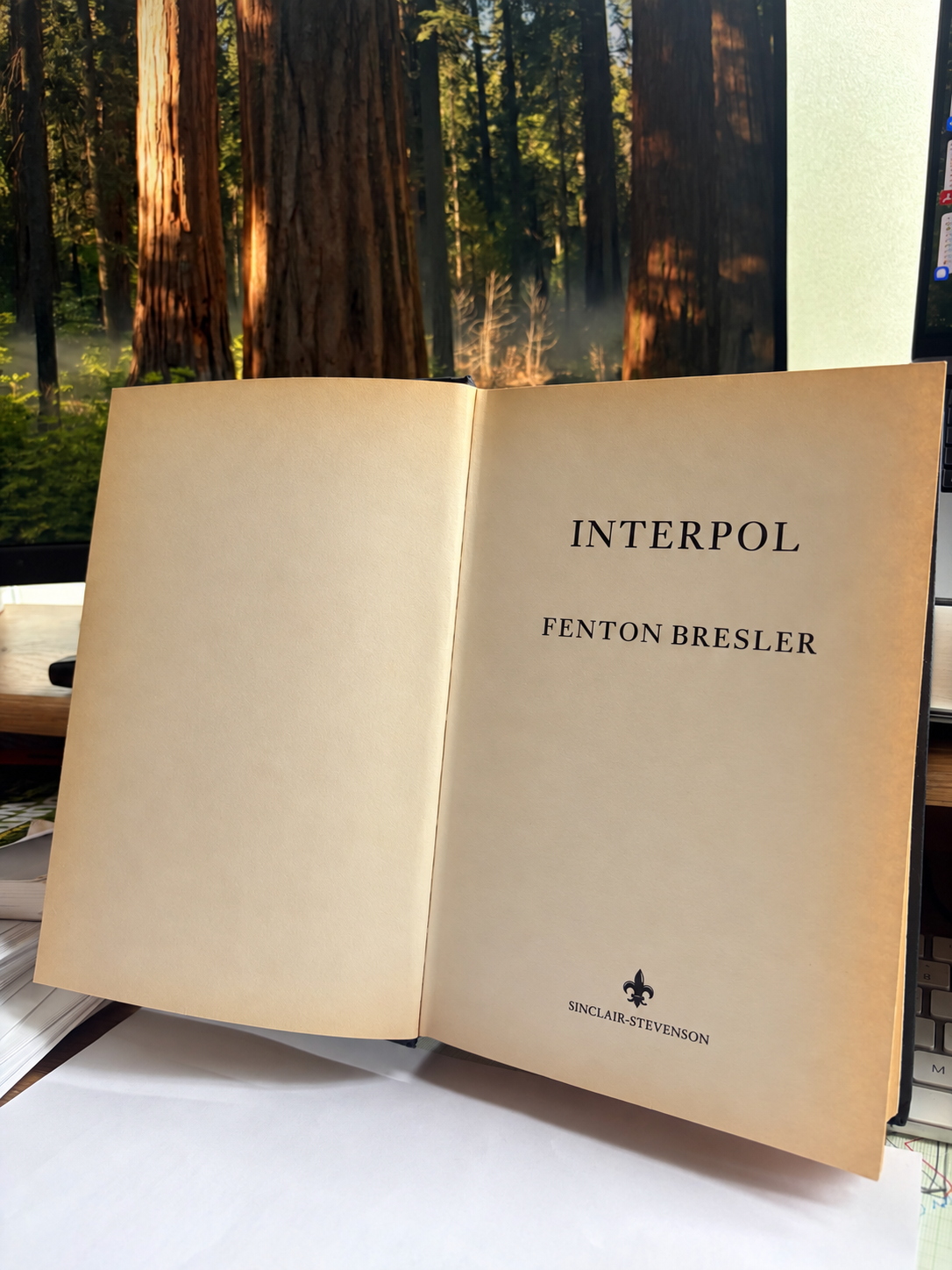
When researching a legal textbook, it is easy to concentrate on the newest source: the latest decision, rule, judgment or policy. Yet one of the most useful sources I found while researching my new book INTERPOL Law and Practice was over 30 years old and cost me £4.23, including postage. It was not a modern practitioner text, an academic monograph or an official INTERPOL publication. It was a second-hand book I found on Amazon. While spending innumerable hours working through CCF decisions, practitioner texts, academic articles, INTERPOL guidance and its various repositories of practice, I happened to type the word “INTERPOL” into Amazon to see what came up.
Among the results was a rather neglected book published in 1992: Interpol, by Fenton Bresler, subtitled A History and Examination of 70 Years of Crime Solving.
It turned out to be one of the most enjoyable and illuminating things I read during the entire research process; so much so that I felt motivated to write this blog about the text.
Who was Fenton Bresler?
Bresler was a practicing barrister as well as a journalist, newspaper columnist, television commentator and prolific author. His subjects ranged from capital punishment and celebrated criminal cases to Georges Simenon, Lord Goddard, the Chinese mafia and the death of John Lennon.
That combination of legal training and journalistic instinct shaped his book on INTERPOL. He was also given extensive access to INTERPOL’s headquarters and to National Central Bureaus in different countries. The result is a lively institutional history, written by someone who had been allowed to observe the organisation from close quarters.
INTERPOL: An organisation with a complicated history
INTERPOL Law and Practice necessarily focuses on the questions facing practitioners today: how Red Notices and diffusions operate, how applications are made to the CCF, and how principles such as human-rights compliance and political neutrality are applied in practice.But to understand the present system, it helps to understand the problem it was built to solve, the culture in which it developed and the assumptions that shaped it.
Bresler’s book sets out the historical narrative behind the legal framework. It contains a highly readable account on the institutional history of INTERPOL, following the organisation through its early development, its expansion during the inter-war years, the period in which it fell under Nazi control, and its post-war reconstruction. He also describes the modernisation associated with Raymond Kendall, the British police officer who became Secretary General in 1985, and the organisation’s move to Lyon.
This history is important. INTERPOL is sometimes spoken about as though it were a supranational police force. It is not. It has no officers who travel around the world making arrests, and a Red Notice is not itself an international arrest warrant. Its power comes from the network: information supplied by one member country can be transmitted rapidly to police and border authorities across the world.
For £4.23, including postage, that was a remarkably useful question to be reminded of.
Reading Bresler from today’s perspective
More than three decades after its publication, much of INTERPOL’s institutional landscape has changed beyond recognition. Yet the central tension running through its history remains unresolved: how can international police cooperation operate effectively while ensuring that its systems are not misused or abused?
This is a question that Bresler does not explore in any great depth. His book was subsequently criticised for presenting an overly sympathetic account of INTERPOL, paying insufficient attention to questions of accountability, the handling of personal information and the safeguards governing its databases.
There may be some justification for those criticisms. Nevertheless, they should not detract from the considerable achievement of Bresler’s work. Drawing on extensive research and unprecedented access to senior officials and internal material, he provided a remarkably detailed account of an organisation whose inner workings were then, and remain today, largely shielded from public scrutiny.
Bresler was writing in a different era and his book appeared before the present Red Notice and i-link system, the contemporary Rules on the Processing of Data and the reforms that created the Notices and Diffusion Task Force (NDTF) and gave the Commission for the Control of INTERPOL’s Files (CCF) a more significant role in deciding access and deletion applications. It also predates much of the modern discussion about authoritarian misuse, transnational repression and the severe immigration, banking and reputational consequences that can follow from INTERPOL data.
That does not diminish the book’s value in explaining why the organisation’s commitment to effective police cooperation remains central when it applies Articles 2 and 3 of its Constitution and balances cooperation against human rights and political neutrality.
Sources and further reading
Fenton Bresler, Interpol: A History and Examination of 70 Years of Crime Solving (Sinclair-Stevenson, 1992; Mandarin edition, 1993). Bibliographic record

Roger Sahota
Roger Sahota is a partner at Berkeley Square Solicitors, co-author of INTERPOL Law and Practice (Sweet & Maxwell), and founding editor of Red Notice Monitor.
He advises individuals on challenging Red Notices and diffusions, including making pre-emptive representations where a request is anticipated.